How the Brain's Anxiety Alarm System Works
Sometimes anxiety can feel like an alarm is going off inside us, but the tricky part is understanding what the alarm is sounding to – real danger or everyday stress?
Anxiety is our body's way of trying to protect us and keep us safe. There is an almond-shaped structure in our brain, called the amygdala, that detects threats. Sometimes, when our nervous system is exposed to stress after a traumatic event, this alarm system can be overly sensitive. When this is happening, the brain may react as if an actual threat is there, even when we are safe, which can lead to feelings of anxiety. When we are stuck in this loop, it can create many internal and external symptoms such as increased heart rate, rapid breathing, light-headedness, and the feeling of fear. The emotional and physical symptoms are real, and it is okay to ask for help.
When Anxiety Is Actually Helpful
Anxiety is uncomfortable but serves a purpose. In Anxiety 101, Moshe Zeidner and Gerald Matthew explain that anxiety aids an individual in adapting to environmental dangers and threats through being the “attention getter” to keep senses heightened in times of perceived danger. Another way anxiety helps is that it motivates the person to act to avoid the events that cause harm or distress with urgency. This keeps us safe! Lastly, it alerts the autonomic nervous system (ANS) to prepare the body for quick action. This allows the body to either escape or confront (i.e. fight or flight). On a lesser scale, anxiety keeps us alert and motivated, for example, during a big exam, but it can also help us when the stakes are higher, like staying vigilant in dangerous situations. Even though they are not perfect, our bodies were designed for us–to protect us from harm.
When Anxiety Becomes Overwhelming
When anxiety goes into overdrive and becomes hypersensitive, it can become disruptive, and even affect our daily functioning. While our brains were indeed designed to keep us safe, there are times when these overactive responses become unhelpful or counterproductive. Suma Chand and Raman Marwaha, who wrote an article called Anxiety, discussed how fear and anxiety are linked. Fear is shaped by how our minds interpret and perceive danger. This is when anxiety shows up and it can grow in intensity and strength when the brain is perceiving more danger in the situation than is actually present, which can create many physical symptoms that feel overwhelming or difficult to manage.
Common Ways Anxiety Shows Up in Daily Life
Chand and Marwaha discuss the many ways anxiety can have roots in many different sources–among medications, herbal medications, substance abuse, trauma, childhood experiences, and panic disorders. Struggling with anxiety can present as a college student who is struggling to concentrate on studying, a new intern with a fear of presenting in the meeting room, and so much more. These feelings can also be met with physical symptoms as well, such as a new mom whose heart beats out of her chest every time her baby cries in public, a child who feels short of breath and dizzy every time they make a mistake, a new employee who sweats bullets every time they are called into the boss’ office to discuss their work. These feelings and physical symptoms can lead to behavioral changes as well, such as avoidance of going out in public for the new mom, difficulty sleeping before the big exam for the college student, or poor evaluations due to inability to sit still in class for the child. There are many ways that anxiety can show up emotionally and physically in the body. Having awareness of this emotion can ease coexistence with its complexities. With that being said, God sees us and meets us right where we are - right in the midst of that restless energy, anxious thoughts, and sweaty palms. And along with healthy interventions and coping mechanisms, we can create an environment that soothes and heals – one that works with your body and not against it.

How to Calm Anxiety With Simple Coping Strategies
Anxiety isn’t the enemy- it is a signal. The question is: what do we do when the signal turns on too high, and we need it turned down?
Imagine anxiety as if you are stranded in the middle of the ocean on a makeshift raft. Although the waves will continue to rise and fall, these are things we cannot control. What we can do is learn how to build a solid boat to weather them, one with sturdy sails and a solid rudder that allows us not to control the waves, but rather to steer ourselves safely through them! Through different healthy coping strategies and interventions, there can be a healthier outcome when you find yourself on the makeshift raft of anxiety. There are many ways to build a stronger boat, and today I will show you one.
Box Breathing for Anxiety Relief
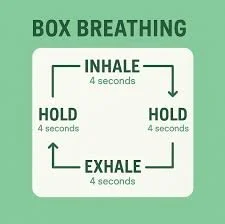
Box breathing is a beneficial coping mechanism that helps calm anxiety when it feels loud. It is a simple but effective coping strategy. Imagine a square or box in your mind, breathe in for 4 seconds, hold this inhalation for 4 seconds, then breathe out for 4 seconds, and then hold the exhalation for 4 seconds. Do this a couple of times while also reflecting on the fact that God is with you. He sees us and hears us in the midst of our anxiety. After a couple of deep breaths, take a break, see how you feel in the present, and tune in to your emotional and physical symptoms.
Building Confidence While Living With Anxiety
Anxiety can feel like a heavy fog; you know there’s a path ahead, but not certain of what lies beyond. That’s okay. Building confidence takes time. Coping strategies do not eliminate the fog but rather they help us learn to walk through it in small steps. It is the ability to act when anxiety is present. Even highlighting and acknowledging the presence of anxiety is a small step. Growth is gradual; that is part of the journey.
It is empowering to take small steps, track progress, and celebrate small wins.
At Dwell, we walk hand in hand with your healing journey. Your story matters, every detail is valued, and every step is guided. We would love to walk alongside you on your journey. If you are ready for more information, we invite you to visit our Anxiety Therapy page. You can also click below to book a free consultation call to learn more about the next steps or contact us now.
We are ready if you are.
Author: Jordan Horton, LCMHCA